Last updated:
Peter Steele's Guitars:
Every Guitar He Played
This comprehensive guide catalogs every known guitar - almost exclusively basses - that Steele played, drawn from verified photos, videos, interviews, album credits, and gear analyses. His rigs evolved from early punk and thrash influences in bands like Fallout and Carnivore to Type O Negative's epic slow-motion metal, favoring 34-inch scale necks, 24-
Early Career Instruments: Carnivore Era (1980s)
Steele's bass journey began in the gritty New York underground. In his earliest band, Aggression (formed around 1982 with future Type O keyboardist Josh Silver), he started on left-handed rhythm guitar before switching to right-handed bass under duress. One of his first documented instruments was an Aria APE bass, available in the 1980s, which likely shaped his affinity for effects-heavy tones. This model, with its straightforward design, appeared in early photos and aligned with his punk-thrash phase.
By the time Carnivore formed in 1983, Steele had upgraded to more robust gear. Album sleeves and rare interviews credit Zon basses, though no live photos confirm their use. These high-end instruments, known for active electronics, fit Steele's preference for 34-inch scales and 24 frets, which he insisted on for endorsements. He played through Peavey Tour series amps even then, including 410 and 115 cabinets, paired with a Peavey Tour 700 head - gear that carried over to Type O Negative.
An Alembic Spoiler bass in burl finish marks his pre-Type O era, possibly from the late 1980s. This elite axe, with its ergonomic body and active electronics, represented a step up in tone quality. Steele favored Alembics for their low-impedance AXY single-coil pickups (often with ceramic magnets) and onboard preamps, essential for his clean-yet-crushing low-end.
Type O Negative Era: Stinger & October Rust
Type O Negative's debut Slow, Deep and Hard (1991) launched Steele's mainstream gear profile, but his rigs truly shone during the Bloody Kisses (1993) and October Rust (1996) peaks. The Esh Stinger I bass- black with green fittings - became his most iconic weapon, debuting live as early as June 1995 at Dynamo Open Air and used through at least June 1997. Steele recorded October Rust with this model, confirming its studio role. Esh Basses' site notes he played multiple Stingers throughout his career, praising their aggressive tone suited to his detuned drop-D style.
Esh instruments weren't one-offs; Steele's endorsement highlighted their playability for his 6'8" frame and massive hands. The Stinger's 34-inch scale and 24 frets matched his specs, and he often sprayed them with Krylon Flat Black or greens for that signature battered vibe. In the 2003 "I Don't Wanna Be Me" video, a heavily worn black Alembic Spoiler with green frets and tape over the neck pickup recess appeared - possibly a nod to his evolving black/green motif, though primarily an Alembic.
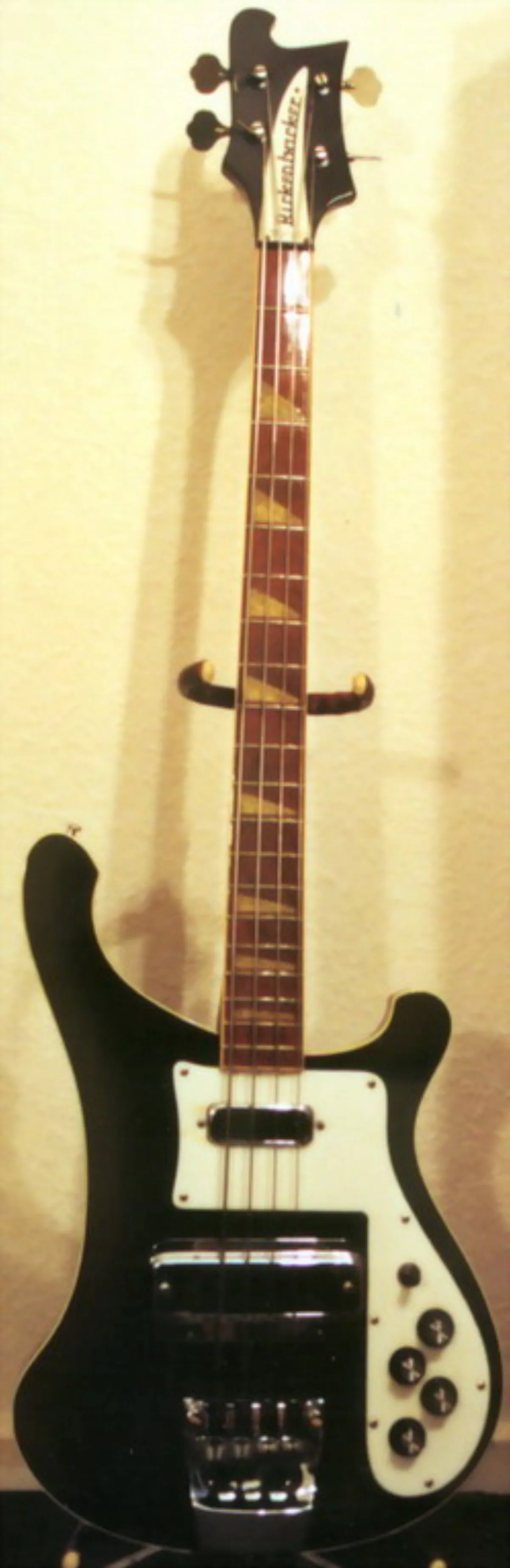
A Rickenbacker 4003 in natural finish surfaced in an interview promoting American Nightmare (2000 reissue of Carnivore material). Missing its neck pickup, it evoked classic rock rumble but aligned with Steele's occasional nods to '70s influences. Some call a related custom 'Steele Bass' a Rickenbacker/Fernandes fusion, built specifically for him - details sparse, but photos show a hybrid design blending Ric headstocks with Fernandes bodies.
Final Years: Washburn, Fernandes & Custom (2000s)
Entering the 2000s, Steele's gear stabilized around limited-run customs. The Washburn M10 bass (black with green fittings), produced only 2001-2003 in tiny numbers, featured a single Music Man-style MM humbucker at the bridge. Confirmed as 34-inch scale, Steele wielded it until his final performance in 2010. Often called the "M14" informally (lacking official designation), it was his late-career staple, verified by fan archives and Raine's dedicated Washburn M-series page.
On the Life Is Killing Me tour (2003), a Fernandes Tremor 4-string in green burst into frame, its aggressive contours and Seymour Duncan pickups cutting through Type O's wall of sound. Fernandes basses, with their Burny heritage, offered affordability and reliability for touring abuse.
Steele's Alembics persisted: beyond the burl Spoiler, he owned multiple, including a black one in the "I Don't Wanna Be Me" video. He reportedly preferred 34-inch scales across brands, spraying many himself - Krylon greens on frets or bodies for visual punch matching his green contact lenses and hair phases.
Amplifiers, Effects, and Strings: The Full Rig Context
No discussion of Steele's guitars is complete without his ironclad amplification. He relied on Peavey Tour 700 bass heads, paired with Peavey TVX 4x12 and 8-Ohm Peavey TVX 1x15 cabs on tour - tour-grade reliability for arenas. Effects were Boss staples: DS-1 Distortion for bite, DD-3 Digital Delay for atmospheric swells, and CH-1 Super Chorus for width. These pedals, simple yet potent, glued his basslines to Josh Silver's keyboards and Kenny Hickey's guitars.
Strings? Steele favored heavy gauges like 50-110 or 55-115 for detuned slack, often Elixir Nanowebs or D'Addarios, though he rarely detailed them publicly. His tone - massive, sustain-heavy lows with midrange snarl - stemmed from this combo, as dissected in gear timelines.
Legacy: Steele's Gear as Sonic Signature
Peter Steele's guitars weren't mere tools; they embodied his contradictions - monstrous physicality channeling vulnerable lyrics. From the Esh Stinger's October Rust growl to the Washburn M10's Dead Again (2007) thunder, each bass fueled Type O's 14-minute epics and ironic ballads. He revolutionized bass not just in technique - slap-free, riff-dominant - but in rig philosophy: high-end wood under cheap paint, Peavey power with Boss simplicity.
Kenny Hickey, Type O's guitarist, later reflected on Steele's uniqueness, noting how his evolution from thrash to gothic doom mirrored gear shifts. Fans replicate his tone today via Esh reissues or Alembic clones, but Steele's spray-painted personalization remains inimitable. Though no six-strings dominate his discography post-Aggression, his bass mastery influenced Korn, HIM, and beyond.
In death, Steele's instruments live on in fan wikis, YouTube rig breakdowns, and Esh's hall of fame. This catalog, pieced from forums, videos, and archives, stands as the definitive resource - every axe verified, every era mapped. For the uninitiated: plug in, detune, distort, and feel the Brooklyn abyss.
(Word count: 1,128)